From the first Vespa in 1946 with its 98 cc, to the most recent version launched in 1992, Piaggio has produced eighty-nine different models; in all these years, almost 20,000 changes have been made to the original project and more than 1,500 parts have been replaced. Without forgetting the many versions of the Cosa, which appeared in 1987.
Piaggio is the worlds only manufacturer to boast both technologies of
scooter production, that of the steel bearing structure which the Vespa
has adopted from the start, and that of the scooter with steel frame and
technopolymer body, which Piaggio inaugurated with the Sfera in 1990. The
Vespa is currently built in Italy, India and Indonesia, with engines from
50 to 200 cc, in the PX (large body) and PK FL2 (small body)
versions and a Classic version for the Japanese market, where it is the
best-selling two-wheeled western vehicle with eight thousand units a year.
A total of approximately fifteen million Vespa scooters have been manufactured
all over the world in the various versions from 1946 to the present day.
Fifty years of the Vespa: the models that have made history
It is difficult to pick out the most representative Vespas from an evolution that has produced almost one hundred models. Some of them are sought after by collectors because they belong to special series, or because they were rapidly replaced by subsequent versions, and are highly priced in the period scooter market, extremely active all over the world. Others, produced in greater numbers or because they stayed on the market for longer, are classic models which have left their mark in the history of two-wheeled mobility.
|
Vespa 125, 1948 - The first Vespa 125 cc. It differed from the 98 not only for the engine size, but also for the introduction of rear suspension; the front suspension was also modified. Vespa 125, 1953 - This marked the first important change to the engine: bore and stroke and the timing gear were modified. The power increased to 5 bhp at 5,000 rpm, and the top speed to 75 km/h. The design of the fairing at the rear was also new. Vespa 125 U, 1953 - The Utility version with spartan styling, which sold at 20,000 lire less than the more modern 125. The headlamp appeared high up on the handlebar for the first time in Italy (it had already been introduced on a number of exported models). Vespa 150 GS, 1955 - Experts called it "the most popular, imitated and remembered model". There were numerous innovations: the 150 cc engine, 4-speed gearbox, standard long saddle, faired handlebar-headlamp unit, wheels with 10 tyres. The Vespa could reach 100 km/h. The design also changed, with a much more aerodynamic body.

Vespa 160 GS, 1962 - This was born to continue the market success of the first GS, with a completely new design. The exhaust silencer, carburettor and suspension were also new. The power output was 8.2 bhp at 6,500 rpm. Vespa 150 GL,1963 - Another new design for what has been called "one of the best-looking Vespas produced by Piaggio designers". The handlebar, trapezoid headlamp, front mudguard and trimmed down rear lids were all new.
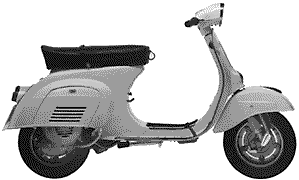
| Vespa 50, 1964 - The first Vespa 50 cc. Born to exploit the new Italian Highway Code which made a number plate obligatory on larger engines. |  |
Extremely versatile and reliable, the engine featured a new architecture, with the cylinder inclined 45° instead of horizontal. It was the last design to leave Corradino D'Ascanio's drawing board.
Vespa 180 SS, 1965 - It marked a new milestone in the growth of the engine (181.14 cc), with 10 bhp for a top speed of 105 km/h. The 180 SS (Super Sport) replaced the glorious GS 150/160 cc. Piaggio modified the front cowling, making it more aerodynamic, and significantly improving comfort, handling and roadholding. Vespa 125, 1966 - Unofficially known as the new 125, it featured radical innovations in the design, frame, engine (inclined 45°) and suspension. Vespa Super Sprint 90,1966 - A special series derived from the Vespa 50/90 cc and the new 125, the hold-all was positioned between the saddle and the handlebar for a more laid-back riding style. The handlebar was narrow and low, and the mudguard and cowling were streamlined. With an engine capacity of only 90 cc, it could do 93 km/h. Vespa 125Primavera, 1968 - Together with the subsequent PX version, it was the most durable version of the Vespa. It derived from the new 125, but with considerable differences in the engine, which raised the top speed by 10 km/h. Great attention was paid to details, which included the classic, practical bag hook.
Vespa 180 Rally, 1968 - With this new vehicle, Piaggio extended the rotary timing fuel feed system to its entire production. The engine was new, the front headlamp new and more powerful, the frame, derived from the Vespa 150 Sprint, was narrower and more aerodynamic than that of the Super Sport. Vespa 50Elestart, 1970 - It featured the great novelty of electric ignition, but the design was also completely revised and embellished compared to the 50 Special. Vespa 200 Rally, 1972 -The Vespa with the largest engine. This model, with 12.35 bhp at 5,700 rpm, could reach 116 km/h. Vespa 125 PrimaveraET3, 1976 -The name stood for Electronic 3 intake ports, and included important changes to the engine, which had more power and sparkle. Even the styling was changed from the standard Primavera (which remained in the range).
 |
| Vespa P 125 X, 1978 - The "PX" marked a new step forward in styling (the bodywork was completely redesigned) and performance. The hold-all was positioned behind the cowling. |
The same year the P 200 E also appeared, which could be equipped with separate lubrication and direction indicators incorporated in the body. Three years later the PX 150 E was launched, with performance halfway between the two models.
Vespa PK 125, 1983 - This replaced the Vespa Primavera (standard and ET3) which remained in production with the Classic body for the Japanese market, where it was the best-selling western two-wheeler vehicle. The styling was new, and the PK body was completely different from that of previous scooters, because the welds of the body no longer overlapped but were integral.
Vespa PK 50, 1983 - Substantially identical to the PK 125, it appeared in two models, PK 50 and PK 50 S, both with 4-speed gearbox and electronic ignition.
Vespa PK 125 Automatic, 1984 - An automatic transmission was introduced on the Vespa, probably the most radical change (at least for the driver) since 1946. The presence of the automatic transmission was emphasised by the absence of the brake pedal, which was replaced by a lever on the left handlebar (which did not have to control the clutch as that was automatic). It was also available with automatic oil-petrol mixer and electric ignition. The following year the Vespa PK 50 Automatic was launched.
Vespa T 5 Pole Position, 1985 - The T 5 was the extra-sporty version of the PX series. With a new engine, aluminium cylinder and 5 intake ports, but the design was also new, particularly at the rear and around the front headlamp which incorporated an aggressive dome with a small plexiglas windscreen. A spoiler was added on the cowling.
Vespa 50 N, 1989 - The changes to the Italian Highway Code meant
that 50 cc vehicles were no longer bound by the 1.5 bhp limit, and Piaggio
presented a new small Vespa with improved performance (over 2 bhp at 5,000
rpm), and new, smoother styling. A Speedmatic automatic version was also
launched but is no longer in production, while, after two successive face-lifts,
the Vespa 50 N is still being produced by Piaggio today.
All information provided taken directly from