SERIES III
L.i. Series 3
L.i, 125 Series III

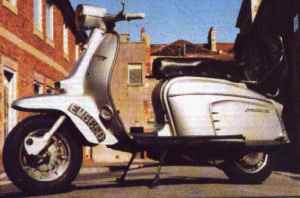
Produced as an ongoing line of Lambretta's, the L.i Series 3 was manufactured in 1962/63. The panel work was redesigned to the 'slimstyle' specification but the engine remained virtually unchanged with 125 and 150cc options. It featured a newly designed front mudguard with a round headlight in a different casting to the Series 2.

T.V. Series 3
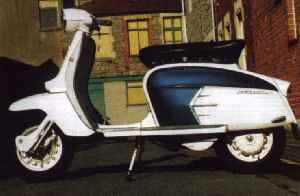
Production began in March 1962 with a 175cc version, 20mm carburettor, improvements to air flow, porting and exhaust, all saw the power up slightly at 8.7bhp. New larger engine mounts and the first manufacturer to introduce a front disc brake to its production bikes helped, improve the T.V 2. Again mid production changes took place with the early ones having L.i style panels, with the center band raised to distinguish them, with the later ones gaining S.X stlye three fingered flashes set into the recess of the panel work. Early colour options of white, and white as a main colour with either yellow or orange as a second, on the horn cast and mudguard, were some of the many colours now available. Further two-tones of light grey/dark grey and ivory/coffee were available, with the later models being offered in white or metallic blue. The metallic blue ones gained their own metallic blue rear frame badges. In October of 1965 the T.V 3 175 came to an end with only 37,794 being built, not quite matching the Series two's figures due to the arrival of the new flagship the, T.V. (G.T.) 200.

Frame & Engine number Identification

Model
Frame
Prefix
Engine
Prefix
Total
Made
From - To
Series 3
Li 125  125LI  125LI  146,734  12/61 - 11/67 
Li 150  150LI  150Li  142,982  01/62 - 05/67 
TV 175  175TV3  175TV3  37,794  03/62 - 10/65 
The 150 version is the easiest to explain. After the prefix, 150LI3, the first model would have the frame number 600,001. The 125 version however, is not quite as straight forward. The first 125 Series 3 had the frame number 001,001, and this continued in sequence upto 148,000. Then for no known reason (to us anyway) the prefix changed to 125LI4 and on these final models the frame numbers re-started at 149,000. The TV Series 3 uses a 6 digit frame number after it's 175TV3 prefix. The frame number commences with a 5 e.g. 175TV3*5_ _ _ _ _. 
L.i. Special (Pacemaker)
L.i 150 Special
In 1963 the L.i 150 Special (called Pacemaker here in the UK, after the pop group Gerry and the Pacemakers) was introduced with several new features. Intended as a sportier version to the standard L.i, the Special was given different styling, by the way of the newly revised Series 3 T.V panel work, including an octagonal headset, front mudguard, horn cast, and side panels. Engine wise the 150 had a change of barrel and head, but strangely not the carburettor of 18mm, giving it a power boost to 8.25bhp compared to the 6.6bhp of the standard L.i. Gearbox was also reworked, to make use of the rise in power, with new closer ratios, which was and remains a favorite of scooter racers. Third gear had a tendency to break because it was so thin, so later models had thicker stronger ones. A 125cc version was introduced in October 1965, (mainly because of tax advantages in Italy) and if anything was a more highly tuned version than the 150. Fitted with a 20mm carburettor, with again changes in barrel and piston similar to the 150, saw the 125 give a power output of 7.12bhp. Once again mid production changes included moving to a larger headset that done away with the chrome ring found between headset and horn cast, black switches instead of grey. Clip in front fork buffers over the earlier bolt in ones, and clip on side panels instead of the usual handle type more commonly known were others. The L.i, and L.i, Specials were sold along side each other for many years, and in all by the time production stopped in October 1966, a very respectable 69,529 150 Specials and 29,841 125's had been produced. With colours options of silver for the 150 and a choice of white or metallic blue for the 125's, many more were offered in the form of limited editions. Many of these limited editions produced, were for no more than promotional purposes and to get rid of old stock. Two such models were the silver special, which wasn't very impressive because they were silver anyway, and the golden special, which was completely including wheels hubs and forks etc, painted in a pale gold colour. The golden special did gain a brown coloured rear frame badge and a similarly brown/green vinyl seat.

Frame & Engine number Identification

Model
Frame
Prefix
Engine
Prefix
Total
Made
From - To
Specials
Li 125 S  125LIS  125LIS  29,841  10/65 - 01/69 
Li 150 S  150LIS  150LI  69,529  09/63 - 10/66 
The Li 125 Series 3 Special was not imported into the UK by Lambretta Concessionaires. A large number have appeared recently as private imports. They are incorrectly called SX 125 although there is no such model. The reason it is confused with the SX range is because of it's close similarity, headlight, panels etc, and the fact that it has a large "Special" badge on the legshields, like the SX models, although instead of a "X150" or "X200" logo it simply has an Li125 below the Special badge. The first Li 125 Special had the frame number 850001. The 150 version, which was manufactured much earlier, has a 6 digit frame number commencing 2_ _ _ _ _. 
T.V. (G.T.) 200
T.V. 200
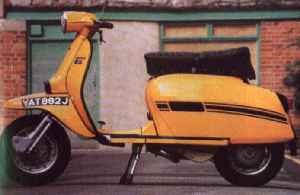
It was the power mad British who eventually brought the 200cc into production. Peter Agg, Managing Director of Lambretta Concessionaires Ltd. in the UK, went to Innocenti to ask for a larger machine, needed for more top end speed. He was refused being told that they were not going to manufacture larger engines, if the British wanted larger machines, they should buy motorbikes. But Peter Agg persisted and eventually Innocenti decided that the British could have the larger capacity, but Concessionaires would have to cover the warranty as Innocenti did not want to know. And so the 200cc became available, a normal 175cc machine being bored to 198cc everything else as it left the factory. The 200 was a success, with great acceleration and a top speed never seen before, but then the problems started with engine mounts that couldn't cope and exhaust that kept falling off. These problems were resolved by fitting two blocks either side of the mounting and another bracket to the silencer, and the rest of the world soon learned that the British had their own machine, with demand forcing Innocenti to produce the T.V. proper. All the modifications of the UK machines were kept, along with different gear ratios and updated carburettor, all improving power output to 10.75bhp giving 70mph. The T.V. 200 was sold in France, Switzerland, USA, Scandinavia and the UK, but strangely not in Italy, making it a minor sales success with 14,982 being built in the short production run that ended in October 1965. Again sharing all the mid production changes of the smaller T.V. 175, the 200 was known in the UK as the G.T. because of the trend in cars being named G.T. or Grand Tourer.


Frame & Engine number Identification

Model
Frame
Prefix
Engine
Prefix
Total
Made
From - To
T.V.
TV 200  TV3  TV2  14,982  04/63 - 10/65 
This model uses a similar set of numbers to the 175 version, with it's own prefix. 
S.X.
S.X. 200
Project Special X was initiated to gain more of a look of quality and attention to detail that Innocenti was renowned for. So the SX was designed with new shape to the headset (hexagonal) new shape to the panels, which now had the three fingered flashes pointing forwards (the 150cc model retained the T.V. type badges). Again 200cc version had the front disc brake, and the S.X was the first Lambretta to gain a 90mph speedometer. The most important changes were to the engine however, with the cylinder, exhaust, head, and piston all reworked to improve power, while reducing vibration. This gave the 200cc an output of 11bhp, although lower than the T.V, with all its modifications the S.X had better acceleration with only a marginal lose of top speed. The 150 had a much better increase over the replaced T.V 175, with output at 9.38bhp, and the gearbox had it's own lower ratio 1st, 2nd, and 3rd gears. Many changes were again made mid production with early ones having white switches, later changing to black, horn cast grilles painted the same colour as the bike, whereas the later models gained polished ones. The majority had handles to secure the side panels, but later these were later discarded in favor of the clip on type of the G.P. Very late on in the production run, machines had silver hubs and wheels with black trimming rubbers, rather than the earlier white wheels and hubs with grey trim, more common to the Lambretta range. By the time production stopped in January of 1969, some three years after beginning, 31,238 200cc versions and 20,783 150cc versions had passed along the production line.

Frame & Engine number Identification

Model
Frame
Prefix
Engine
Prefix
Total
Made
From - To
S.X.
SX 150  SX150  SX150  31,328  10/66 - 01/69 
SX 200  SX200  SX200  20,783  01/66 - 01/69 
The first SX 150 had the frame number 750001 and the first 200 version had the frame number 830.001
G.P (D.L)
G.P. 200 Electronic
The L.i 125 Special, S.X 150 and 200 which had been available, were all replaced by the new Bertone designed Lambretta G.P (D.L.) range. It was offered in three engine sizes, again 125, 150 and 200, which had many improvements over its forebears. Porting changes, new crankshafts with thicker flywheel taper, a big end with more end float, enabled the new engine to cope with the higher revs that it was designed to run at. 125's and 200's shared a new closer ratio gearbox (although the 200 uses different 18-47 sprockets with longer chain), while the 150 retained the gearbox from the S.X 150. Clutch, kick start and 22mm carburettors (20 for the 125) were other modifications applied to the new G.P, giving the highest ever output quoted for a Lambretta. 7.3 for the 125, 9.4 for the 150, and 12bhp for the 200 gave a great acceleration and top speed for the new models. Strangely despite all these changes, the engine casing were never stamped G.P. or D.L. The 125 was stamped Li125, the 150 stamped SX150 and the 200 being stamped SX200. Body work changes included a new rectangular headlight, shorter head stock, trimmed and restyled mudguard, rear light unit and smoother panels with speed strips, all combined to give a sportier image for the new model. Ink splots (supposedly due to an argument when Bertone threw his pen down on the plans after an argument with Innocenti, over trim colours) were the main logo, except in the UK where checkered flags were used to go with its Gran Prix name. The 125 had colour options of white or turquoise, the 150 white, red, orange or yellow ochre, with two-tone options of white/blue white/red, (the second colour on the horn cast and side panels), whilst 200cc owners could choose from white, red or yellow ochre. Again as with almost all other models before, Innocenti made mid production alterations. To begin with early machines had painted horn and seat grilles, with the later black plastic. Metal petrol flaps and grey plastic toolboxes gave way to black plastic petrol flaps and toolboxes. Finally, it is often thought that it was the Indians who decided to use bolts, instead of studs and nuts to secure the chaincase cover, but in fact the very last G.P's to roll of the production line were secured in this way. By June 1970, just 10 months before production ceased a new model was being offered. The electronic (200cc only), as its name suggests, came with electronic ignition to give a maintenance free system with improved reliability and starting. By the time the new model arrived in the UK, it sported a different seat with waffle stlye cover and electronic logo for the leg shields, to differentiate it from the standard G.P 200. Sadly in April of 1971, the last ever complete G.P rolled off the production line, with 15,300 125's, 20,048 150's (plus another 1,402 sold in kit form to other markets) and 9,350 200 being produced.

Frame & Engine number Identification

Model
Frame
Prefix
Engine
Prefix
Total
Made
From - To
Grand Prix (DL)
GP 125  22/1  LI125S  15,300  01/69 - 04/71 
GP150  22/0  SX150  21,450  01/69 - 04/71 
GP200  22/2  SX200  9,350  01/69 - 04/71 
The first frame numbers of the 3 versions are as follows :- 125 = 22/1*002,001, 150 = 22/0*200,001, 200 = 22/2*250,001 

BACK